Saturday, February 17, 2007

Marketing 101-- What not to do.

I regretted that I did not get any Bow Rests ready for the Oct. 1 opening of bow season, but by October 15 I had fifteen ready for sale. Wanting to see what value people would put on the Bow Rest I put one on a seven day auction on Ebay with a starting bid of $39.95. After three days there were no bids, but 15 people were watching the item, encouraging I
My Ebay pictures
thought. Then the first bid came in at the minimum. Later I learned that the bid was by a friend who had wanted a Bow Rest and wanted to get the bidding started, "stir the pot" as he described it. Well, it turned out that he bought it for the minimum bid. Next I resubmitted as a seven day auction with a minimum bid of $0.99 and asked my friends not to bid so I could see what value people in general put on my product.

Unfortunately, this time there were about 30 watchers, but no bidders until the last day. It actually went for $1.04, just two bids! This was revealing indeed. When I show bow hunters these pictures in person, the usual response is "Looks like a great idea." Why then were people unwilling to place a reasonable value on the Bow Rest?

What did I learn from this experience? Apparently Ebay is not the place to introduce a new idea or product. Lesson number two: PayPal sent an email asking whether I wanted to accept the bid of a person with no feedback, and I foolishly said yes. This person had nothing to gain by sending a report since he had no feedback record to spoil. Therefore why bother to send a report?

How could I get my message out? All my sales (all three of them) were to people who knew me and were aware of my success with the Bow Rest. Being 73 years of age, almost all my friends had given up bow hunting long ago. I figured I needed a web site where I could present the Bow rest to the public in general. Never having had a web site before, I naively assumed that if you put up a web site, people will find it using the search engines and I would have a national market for the Bow Rest. I found a hosting company that offered to register a domain name, prepare a web site, and submit the site to the search engines for only $80 per month. With my limited resources this sounded pretty good.

The domain name bowrest.com was taken, but I was told that my second choice, bowstabilizer.com was available. By email I sent in pictures of my bow rest, a description of what it does and how it works, and its features (shoot more accurately, hold a draw longer, minimizes game spooking movement, etc.). What I got was a web site that had none of my pictures or information and which was totally inappropriate. Fortunately they had a web modification program that was very good. In two weeks of trial and error I was able to come up with a reasonable web site.


I published it to the web, but was unable to get to it by typing the url into my browser. Instead I got a site offering the domain name for sale for $900. When I complained to customer service, I was told to wait and they would get the domain for me. I certainly knew they would not pay $900 for it, but I trusted that they were true to their word. Days went by, more calls to customer service, but still no results. Finally I talked to someone who actually looked into the situation and recognized that the domain name was not available. The person who told me bowstabilizer.com was available had erred. Bowstabilizer.net was a suggested alternative and I accepted it. Finally, after three weeks the web site was finally on line (www.bowstabilizer.net).

I soon realized that even a week after the hosting company submitted my url to the search engines, only on Yahoo was I able to find my site when searching for Compound Bow Rest & Holder, and it was on page four. When I search for a given term I rarely look past the first page for sites. So how do you get traffic to your site? I saw that I had a lot to learn.

Continued on the next post.

Tuesday, February 6, 2007

Manufacturing the Bow Rest

(I have been laid up with the flu, too sick to do much of anything for the past week, hence the lack of a post.)

In October, 2005 I had contracted to have a 34’x60’ metal building put up for a workshop. This was to free up our basement and garage which was cluttered with snow blower, riding lawn mower, small garden tractor, motorcycle and tools. I had no idea what I was going to do with all that shop space at that time, but I wanted to move into the workshop before winter so I could garage our vehicles. Mother Nature poured frozen water on that plan; two days before a cement pad was to be poured we got eight inches of snow. That put the building on hold until spring.

From my last post you will recall that by the spring time I had decided to manufacture the Compound Bow Rest and Holder myself on a small (500 units) scale and try to market them. The shop building I had already contracted seemed like an ideal “factory”, only a mile from our house. I wanted to have some inventory of the Bow Rest in time for bow hunting season which started October 1. While my shop was being built, I sought sources of supply. My concept at that time was to contract out to have pieces made, and I would basically put the Bow Rests together, paint and package them and they would be ready for shipment. How naïve! The quotes that came back for producing the parts were so high that each Bow Rest would cost me about $100 by the time it was ready to ship. This was more than I could charge, and it left nothing for profit.

When reality set in, the whole tactic changed. I was going to have to manufacture the parts myself, and to do so I would need machines to make the parts consistent and interchangeable. It took the next three months of frenzied activity to first design, and then to build the jigs and machines. Most of them failed to perform satisfactorily as first conceived, and some went through as many as five model changes before being deemed satisfactory. Much more ingenuity and creativity went into this activity than into the invention itself! I gained a new appreciation for those who provide tooling for manufacturing.


The shop building was ready for occupancy about July 20, and after moving in the setting up of tools, jigs and my machines used up August. I hired a friend from our church, a recovering alcoholic who had been dry for 18 months, to help me with production work. The weekend before he was to start he fell off the wagon and did not show up on Monday morning. I stopped at his house to see why and he was falling down drunk. I drove him to a hospital 30 miles away to dry out, but that ended his employment before it started. Fortunately my son came for a month long visit from California shortly thereafter, and between the two of us we were able to make parts for at least 100 Bow Rests. Approximately 20 were assembled, painted and ready to be boxed. We learned by adding up the time for each step in the manufacturing process that I took slightly more than 4 hours to manufacture a boxed bow rest. That is if nothing broke down during the process, which turned out to be a totally unreasonable assumption.
The positive side of doing my own manufacturing was that people were very interested in seeing how the various machines worked. All were powered by muscle, and particularly children had a ball making metal "belt loops", bending loops in 3/16" rod for the spreader, and cutting 1/4" steel rod for the boom. One 12 year old remarked after trying several of the machines, "This is the best day of my life!" Touring the "factory" created a lot of local interest in the Bow Rest.

The costs for raw materials in the manufacture was very reasonable, coming in at around $9.17 per Bow Rest, but the packaging cost even more, $15. This is because two “cookie cutters” for cutting the cardboard box and an insert had to be made. The 8”x48”x2” boxes and inserts themselves cost only $1.20, but when the cost of the cutters was added in the cost per box for a 500 lot was $12. This was discouraging! Putting a label on the boxes with pictures and description would have been another $5.45 per box if done by the box maker. This is because the major cost for the label is setup, and 500 boxes is a very small run. I opted to have self-stick labels printed for $3.25 each and put them on myself. Total cost then for a boxed Bow Rest: approximately $24 plus a half day’s work.

Continued in my next post.


Thursday, January 25, 2007

The Vultures Circle

Continued from my January 24 post.

A patent is only a nice decoration unless you can make money with it. As soon as the patent issued I started getting mail from companies that want to represent you in presenting your patent for licensing. Within two weeks I must have gotten ten of them. Their tactic:

1. Flatter-“We have chosen your patent from among thousands as one that has great commercial appeal.”
2. The hook-“These are products that we have helped introduce to the market”, with pictures. “We believe your invention has similar potential.”
3. The price- Their fees for services range from up front fees of $600-$35,000, plus from 5-30% of royalties, but you did not learn their prices until you called them and endured the hard sell.

The experience reminded me of a common scene in western movies, vultures circling over a dead or dying critter. I am sure some of the companies were legitimate and do give valuable service for your money, but being a skeptic, I checked better business bureaus and on line complaints. What I found left me skeptical of all of them. Every one of them I investigated had numerous complaints by people who felt they were ripped off. Not wanting to join the ripped off club, I put together a brochure with pictures of the Compound Bow Rest and Holder and a description of what it does and how it works. Then I searched Google for web sites of companies that sell bow hunting equipment, and sent emails from their contact page with pictures I had taken for the brochure. Most did not even answer, but those that did basically said to get the Bow Rest manufactured, and then contact us. One company did send a letter saying that they were looking into licensing the patent, but I never herd further from them.

Since I had tried my tactic for four months and failed, I thought perhaps I would try one of the companies that had originally contacted me about licensing. I got a letter from one of the cheaper services that had contacted me previously, offering me a special deal. For only $50 they would represent me to manufacturers for licensing. If they got a hit they would share in the royalties. This sounded like a pretty good deal to me. At least they think enough of my invention to put some of their time and money into seeking a license. I sent them my brochure so they could reproduce it and also have additional information concerning the invention in addition to the patent.

Two months went by and I had heard nothing from the company. When I called I talked with someone who had no knowledge of me or my invention. I was told to wait another month and I would hear from them. I did. I got a letter stating “Sorry, nobody was interested in your invention.” No explanation of what they had done or who they had contacted. Hmmmm! It sounded to me like I may have been scammed out of $50. I’ll bet they did nothing. They probably sent the same offer out to all the inventors as a follow up to their first letter. A $50 fee for nothing is as good as $600 for time and effort on their part. But as I admitted earlier, I am a skeptic. They could have done something on my behalf and I would never know.

Shortly after this experience I received a letter with another letter with an interesting offer. This company offered to make the product in China (they have offices both in China and the US) and they would market the product for 15% of the net profits, with 85 going to me. They wanted $13,750 for “tooling”, $9,212.50 upon signing a contract and $4537.50 when production was ready. While this was interesting, it was too risky considering that I would have to borrow the money for tooling. I decided I would rather take my chances making the product myself and introduce it in the market on a small scale rather than jump into an enterprise with both feet. Perhaps it won’t sell. Besides, could I trust this company since all of the risk is mine, but they get paid up front? Like I said, I am a skeptic.

Continued in the next post.

Wednesday, January 24, 2007

Patent on a Shoe String

Continued from my last post.

The clock was ticking. I had one year from the filing date of the provisional patent, June 5, 2002 to file my utility patent application. Since I fired my first patent attorney, where do I find another one whose fees fit the budget of a senior citizen on a fixed income? I checked with a couple, both said that their fee would be upwards of $8,000, and the lower retainer of the two was $2,500. I explained that a patent search had been made and a provisional patent filed, so all that was needed were the drawings and claims. Their retort was that in order to do a good job they would have to be familiar with previous patent literature and understand the present invention thoroughly. At $250 per hour (including coffee breaks I presume) it doesn’t take long to run up an $8,000 bill.

I knew I could produce the drawings with the help of a local artist. After downloading the instructions from the Patent Office web site, I proceeded to make the drawings according to their specifications, but then out sourced the free hand drawing at a cost of $120. The provisional patent manuscript was revamped to accord with the part numbers on the drawings. Writing the claims, however, concerned me. It is the claims that prevent infringement of your patent, and if not well written to cover all the loopholes your patent may be worthless.

I heard from a friend who teaches at the local Michigan Technological University that one of the university employees had recently been licensed as a patent agent. While not an attorney, he can represent others in dealings with the Patent and Trademark Office. The “recent” label worried me a bit but I contacted him and asked if he would be willing to write my claims for a fee. He declined but offered to act as a consultant for free.

Armed with the promise of his help and an intense reading of the claims of many patents, I felt confident I could write claims that would protect my invention. After innumerable rewrites and three consultations with the patent agent I was confident that the claims were air tight. The patent application was ready for filing. The manuscript along with several forms and a filing fee of $150 was sent on May 30, 2003. It arrived at the Patent Office on May 30, just six days before the deadline! Then began the long wait for the “first reading”, the report back from the patent examiner.

In August, 2004 I received a very official looking manila envelop from the Patent Office. With trepidation I opened it to find that all my claims had been denied. I was devastated! While I had been warned that this denial often occurs, I had been confident that my claims were thorough, reasonable, and did not infringe on the claims of any other patent. The examiner also had the audacity to say, “It is obvious that the applicant is not knowledgeable in the art of writing claims. It is strongly advised that he consult a patent attorney.”

The examiner’s telephone number was included in the report so I call asking him what was wrong with my claims. The examiner’s name was Ramon O. Ramirez, and to my surprise he was friendly, helpful and a very nice person. I was expecting an ogre. He said there were two problems with my claims:

1. The claims should describe what the invention is, not what it does.
2. Each claim should describe only a single entity, some of yours describe multiple entities.

I asked Mr. Ramirez if he would critique a new set of claims on an informal basis before the final submission and he agreed. With these two simple comments I was able to rewrite the claims and fax them to him. Several days later he called to say that if two words were changed he would accept my eleven claims. The changes were made in the manuscript and it was resubmitted. What a difference a little knowledge can make! True to his word, in January, 2005 I received a Notice of Allowance. I was home free! Well, not exactly free, along with the Notice was a $700 bill for the issuance of the patent. It issued on September 27, 2005 and I received a copy of patent no. 6,948,690 in a beautiful cover with the gold seal of the Patent and Trademark Office along with the director’s signature.

Thursday, January 18, 2007

Patent Pending

Continued from my Jan 17 post.

Because the bow steady rest helped my shooting accuracy so dramatically, I figured perhaps there would be a market for such an item. The US Patent Office has a search site (http://www.uspto.gov/patft/) to allow inventors to search by keyword through the patent literature for patents with similar functionality. A thorough search indicated that the idea was novel and thus patentable. I then searched for a patent attorney using Google, and from the names provided chose a patent attorney who also had a mechanical engineering degree. When I contacted him and described my invention I was given a price of $1,850 to write a provisional patent, and then was told that the utility patent would only cost about $1,000 more. I paid the $1,800 and sent him every bit of information I could think of concerning the bow steady rest along with a few pages of drawings. What I got back from him indicated that he either he did not take the time or was unable to understand what the invention was all about. The draft of the provisional patent application was so bad that rather than try to correct it, I completely rewrote it. After submitting it to the attorney I got a bill for $250 for "revisions". When I protested that charges for revisions were not in his price quote, he claimed it was for retyping the manuscript. Since my draft of the provisional patent application contained only 1,800 words, even a moderately competent typist could do the typing in an hour. It was clear working with this guy was going to be expensive, so I fired him and submitted my draft to the patent office. A provisional patent application is basically a description of the invention without any claims. Anyone can write one. A patent examiner doesn't even read it when it is submitted. What it does is give you a submission date for the idea and buys you one year of time to produce a real patent (a utility patent). At this stage if you want to market your product you can claim "patent pending" status. I had no intention of marketing the bow steady rest myself. To license an idea you need a utility patent, and I had only one year to come up with one. The saga continues with the next post.

Vernon Sandel

Monday, January 15, 2007

Anatomy of a Patent

When I was younger I thought that at 73 years of age I would be spending my time relaxing, watching TV, and doing the "Honey dos". Instead the last five or six years have been some of the busiest in my life. At least that's the way it seems to me now. Of course at this age one is never too busy to take a nap when necessary.

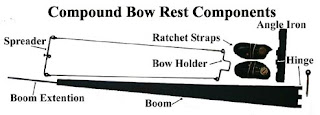
There are so many things to be done before the pall bearers carry me to the hearse! First, there is the Compound Bow Rest & Holder. This story begins roughly six years ago. I was an avid bow hunter (white tail deer) for a number of years, but as I weakened with age, I could not consistently group my arrows within a 6" circle even when shooting at 15 yards. Since this is the minimum accuracy I consider necessary for bow hunting to avoid wounding instead of killing, something had to be done to improve accuracy or I had to give up bow hunting. I came up with the idea of a boom system that straps to a tree with ratchet straps, is hinged to allow the boom to swing horizontally, and a support system that attaches to the bow at the riser and steadies the bow.

Immediately my shooting accuracy increased dramatically. I could actually hold my sights on a bulls eye for seconds without drifting off. At 22 yards I had to shoot successive arrows at different spots on my target because I destroyed several arrows by hitting the first with the second. I had a friend try it, and his arrow struck dead center of the bulls eye. (I was perplexed by his reaction, he was amazed but refused to shoot again.)

From that time on I never missed a deer with the bow. I wish I could say that I never wounded one either, but unfortunately I cannot. In 2004 I shot a 6 or 8 point buck at 18 yards from a 20' tree stand. At the time I was using mechanical broadheads (the type that open up upon impact) because they fly truer than the fixed broadheads. However, the down side of the mechanicals is that some of the penetrating power is lost in opening the broadhead. Since I hunt with a low draw weight of 50 lbs, the arrow apparently only penetrated one lung. I followed a blood trail for 3/4 mile, and then lost it. A deer can run a long ways on one lung. Also, that was the only deer I have ever shot where I did not find the arrow. I presume I hit a rib and the arrow wedged in tightly.

I greatly regret this experience, and I have since used only fixed broadheads. I never did get a deer that year.

The story continues in the next blog.